
Advanced Python Course at NTITS Institute: Master Python for Real-World Development
Python has become one of the most widely used programming languages for software development, automation, data science, artificial intelligence, web development, and application development. While learning basic Python helps you understand programming fundamentals, an Advanced Python Course can take your skills to the next level by introducing professional programming concepts and real-world development practices.
NTITS Institute offers an advanced learning path for students, graduates, working professionals, and aspiring developers who want to strengthen their Python programming skills through structured learning and practical concepts.
Whether your goal is to become a Python developer, work with automation, build applications, or prepare for technical career opportunities, advanced Python training can provide a strong foundation for professional growth.
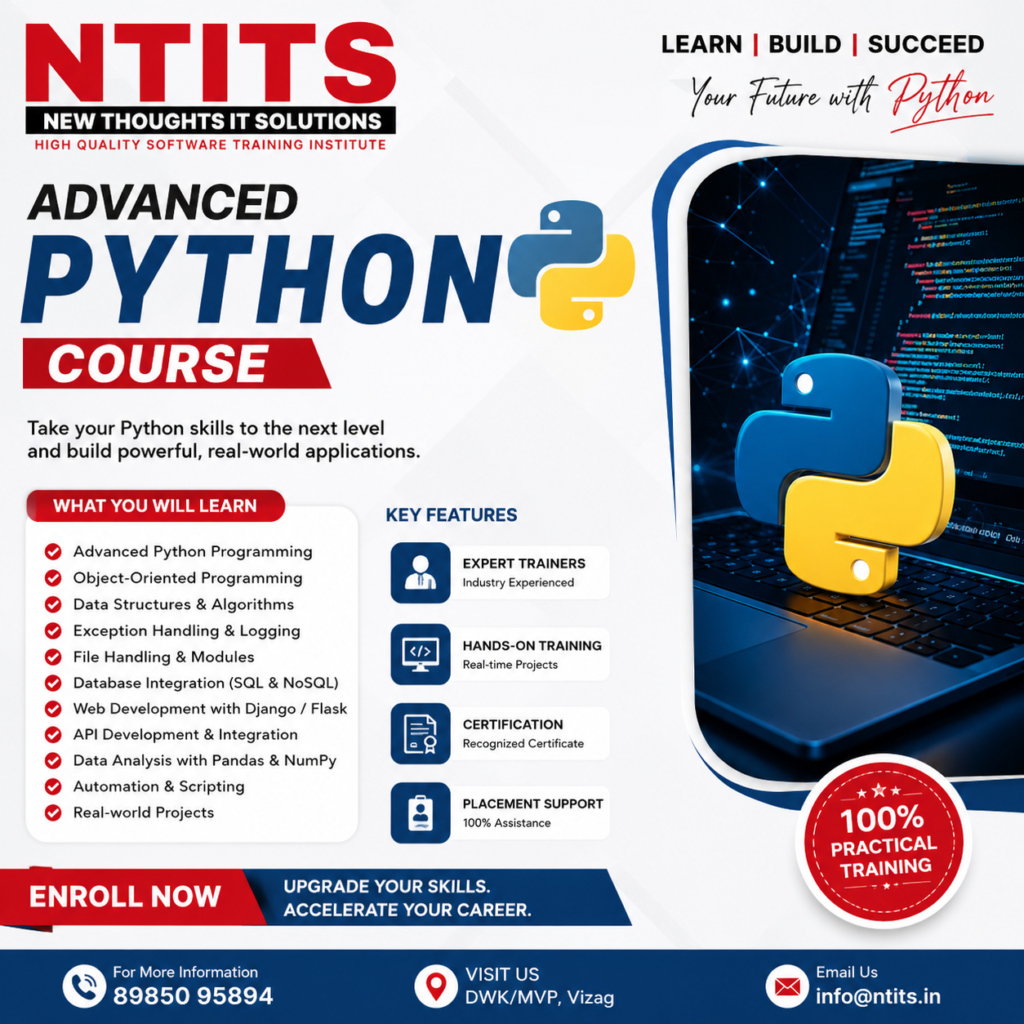
What Is an Advanced Python Course at NTITS Institute?
An Advanced Python Course focuses on concepts that go beyond Python syntax and basic programming. It helps learners understand how Python is used to create efficient, maintainable, scalable, and production-oriented applications.
The course can introduce learners to important areas such as:
- Object-oriented programming with Python
- Advanced functions and decorators
- Exception handling and debugging
- Iterators and generators
- File handling and data processing
- Modules and packages
- Regular expressions
- Database connectivity
- APIs and web services
- Multithreading and multiprocessing
- Python application development
- Testing and code optimization
- Practical projects and development workflows
The objective is to move learners from simply writing Python programs to thinking and developing like a professional Python programmer.
Why Choose an Advanced Python Course at NTITS Institute?
Choosing the right training environment is important when developing technical skills. An advanced Python program should combine conceptual understanding with practical implementation.
At NTITS Institute, learners can focus on building a stronger understanding of Python while exploring how programming concepts are applied in practical development scenarios.
1. Build Advanced Programming Skills
2. Learn Through Practical Concepts
3. Strengthen Problem-Solving Ability
4. Prepare for Python-Based Careers
Key Concepts Covered in Advanced Python Training
A well-structured Advanced Python Course should cover several important areas of professional Python development.
Object-Oriented Programming
Object-oriented programming is an important skill for building organized and reusable applications. Learners can explore classes, objects, inheritance, polymorphism, abstraction, encapsulation, and other OOP principles.
Decorators
Decorators allow developers to modify or extend the behavior of functions and methods without changing their underlying implementation. They are commonly used in advanced Python applications and frameworks.
Iterators and Generators
Iterators and generators help developers work efficiently with data and can be particularly useful when processing large amounts of information.
Exception Handling
Professional applications need reliable error handling. Advanced Python training can teach learners how to identify, handle, and debug exceptions effectively.
Modules and Packages
As applications become larger, organizing code becomes essential. Python modules and packages help developers create structured and reusable projects.
Regular Expressions
Regular expressions can be used for advanced text processing, searching, validation, and data extraction tasks.
Database Connectivity
Python applications frequently interact with databases. Understanding database connectivity helps learners develop applications capable of storing, retrieving, and managing information.
APIs and Web Services
Modern applications often communicate with external systems through APIs. Learning how Python interacts with APIs can help developers build connected applications and services.
Multithreading and Multiprocessing
Advanced Python concepts can also include techniques for handling multiple tasks and improving application performance where appropriate.
Practical Learning and Projects
One of the most valuable parts of advanced programming education is project-based learning. Instead of focusing only on theoretical concepts, learners can use Python to solve practical problems.
Possible project areas include:
- Python automation tools
- Database-driven applications
- REST API-based applications
- Web applications
- Data processing projects
- File management systems
- Business utility applications
- Python-based automation projects
Projects help learners understand how individual Python concepts work together in a complete application.
Who Should Learn Advanced Python?
An Advanced Python Course can be useful for:
- Students who already know Python fundamentals
- Computer science and IT graduates
- Beginner Python developers looking to advance their skills
- Working professionals wanting to upgrade their programming knowledge
- Aspiring software developers
- Professionals interested in automation and backend development
- Learners planning to move toward data science or AI/ML
A basic understanding of Python programming is generally recommended before starting advanced-level training.
Benefits of Learning Advanced Python
Advanced Python skills can provide several benefits for learners.
Better Coding Practices
You can learn how to write cleaner, reusable, structured, and maintainable code.
Improved Development Skills
Advanced concepts help you approach programming problems with greater confidence and technical depth.
Wider Career Opportunities
Python is used in multiple technology fields, making advanced Python knowledge applicable to several career paths.
Stronger Project Portfolio
Practical projects can demonstrate your programming capabilities to recruiters and potential employers.
Foundation for Specialized Technologies
Advanced Python knowledge can make it easier to explore areas such as Django, Flask, Fast API, data science, machine learning, automation, and artificial intelligence.
Advanced Python Course and Career Growth
Python continues to be an important technology for modern software development. However, completing a course alone does not guarantee a job. Career growth depends on practical skills, project experience, problem-solving ability, communication, interview preparation, and continuous learning.
For this reason, learners should use their Advanced Python Training as a foundation for building projects and developing job-ready technical skills.
How to Get the Most From Advanced Python Training
To maximize your learning experience:
- Practice Python regularly.
- Write code instead of only watching lessons.
- Build small projects after learning each major concept.
- Learn to debug your own programs.
- Study Python documentation and coding standards.
- Work on progressively more challenging projects.
- Create a portfolio of your best work.
- Continue learning frameworks and tools after completing the course.
Conclusion
An Advanced Python Course at NTITS Institute can be a valuable step for learners who want to move beyond basic Python programming and develop stronger professional programming skills.
By learning advanced concepts, practicing problem-solving, working on projects, and exploring real-world applications, learners can build a solid foundation for Python-based development careers.
If you are ready to strengthen your Python skills, advanced training can help you progress from writing simple programs to developing more structured and practical applications.
Frequently Asked Questions (FAQs)
1. What is an Advanced Python Course?
An Advanced Python Course teaches professional-level Python concepts beyond the basics, including object-oriented programming, decorators, generators, exception handling, database connectivity, APIs, concurrency, testing, and practical application development.
2. Who can join an Advanced Python Course?
Students, graduates, aspiring developers, and working professionals with basic Python knowledge can consider advanced Python training.
3. Is basic Python knowledge required?
Yes. Understanding Python fundamentals such as variables, data types, loops, functions, and basic data structures is recommended before starting an advanced course.
4. What can I do after learning advanced Python?
You can explore roles and technologies related to Python development, backend development, automation, data analysis, web development, data science, and AI/ML.
5. Does an Advanced Python Course include projects?
Project-based learning can help learners apply advanced Python concepts to practical applications. The specific projects and curriculum may vary by program.
6. Is Python good for a software development career?
Yes. Python is used across software development, web applications, automation, data-related technologies, and artificial intelligence, making it a versatile programming skill.
7. How long does it take to learn advanced Python?
The learning period depends on your existing Python knowledge, course structure, practice time, and project experience. Consistent hands-on practice is more important than simply completing lessons quickly.
8. Can beginners learn advanced Python?
Beginners should generally start with Python fundamentals before moving to advanced concepts. Building a strong foundation makes advanced topics easier to understand.
9. Why choose NTITS Institute for Python training?
NTITS Institute can be considered by learners looking for structured technical training focused on developing Python programming knowledge and practical skills. Prospective students should review the current curriculum, trainers, course duration, projects, and certification details before enrolling.
10. Is certification important after completing Python training?
A certificate can document course completion, but practical programming ability, projects, problem-solving skills, and technical knowledge are especially important when pursuing Python-related opportunities.