
UI/UX Design Course at NTITS Institute
In today’s digital-first world, businesses need websites and applications that are functional, attractive, simple, and easy to use, making UI/UX design an exciting career option for students, graduates, and aspiring creative professionals. The UI/UX Design Course at NTITS Institute helps learners understand effective digital experiences while developing practical skills in user research, wireframing, visual design, and interactive prototyping, providing a strong foundation for building a successful career in the digital design industry.
What Is UI/UX Design?
UI stands for User Interface, while UX stands for User Experience. UI design focuses on the visual and interactive elements of a digital product, including layouts, colors, typography, buttons, icons, and overall visual consistency. UX design focuses on how users interact with a product by understanding user needs, identifying problems, organizing information, creating user flows, and testing solutions. Together, UI and UX help create digital products that are visually appealing, intuitive, and useful, making a UI/UX Design Course a valuable choice for anyone interested in designing effective digital experiences.
Why Choose a UI/UX Design Course?
Learning UI/UX design can be valuable for people who enjoy creativity, technology, problem-solving, and understanding user behavior.
A structured UI/UX design course can help students:
- Understand fundamental UI/UX principles
- Learn user research and persona development
- Create user journeys and information architecture
- Develop wireframes and prototypes
- Improve visual design skills
- Understand responsive design concepts
- Work with modern design and prototyping tools
- Build practical projects for a portfolio
- Develop skills relevant to digital design careers
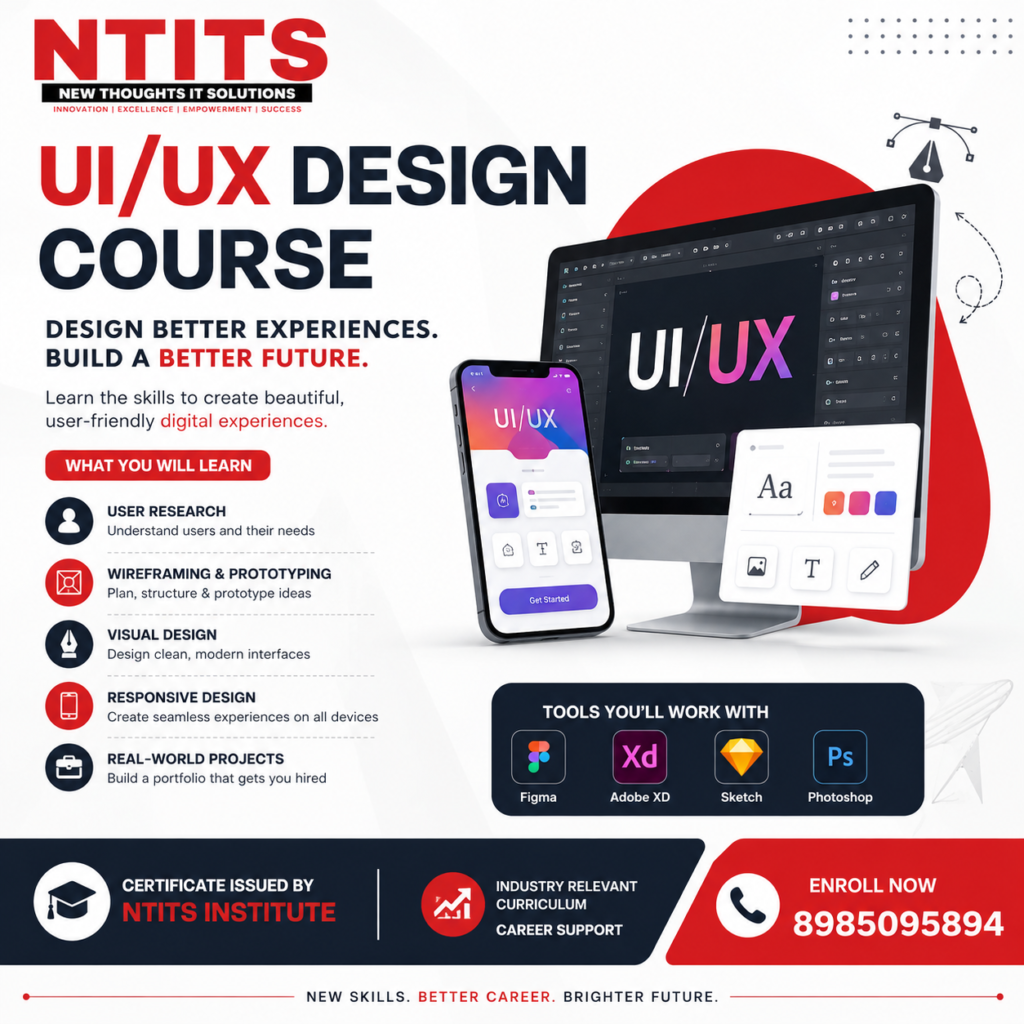
UI/UX Design Course at NTITS Institute
The NTITS Institute UI/UX Design Course can be positioned as a practical learning program for individuals who want to develop industry-relevant design skills.
Students can explore the complete design process, starting with understanding a user’s problem and progressing toward designing and testing a digital solution.
Key Areas You Can Learn
1. UI/UX Fundamentals
Understand the difference between UI and UX and learn the principles that influence effective digital experiences.
2. User Research
Learn how to identify user requirements, understand pain points, and organize research findings to support design decisions.
3. Wireframing
Create low-fidelity layouts to visualize the structure and functionality of websites and applications before developing detailed designs.
4. Prototyping
Turn design concepts into interactive prototypes that demonstrate how users may navigate through a digital product.
5. Visual Design
Explore typography, color, spacing, composition, grids, and other elements that contribute to an effective interface.
6. Responsive Design
Understand how interfaces can be designed to provide a consistent experience across desktops, tablets, and mobile devices.
7. Portfolio Projects
Practical projects can help learners demonstrate their design thinking and problem-solving abilities when applying for internships or jobs.
Who Can Join a UI/UX Design Course?
A UI/UX design course can be suitable for:
- Students and recent graduates
- Beginners interested in digital design
- Graphic designers looking to expand their skills
- Web designers and developers
- Marketing professionals
- Entrepreneurs and startup founders
- Professionals planning a career transition
- Anyone interested in creating better digital experiences
You don’t necessarily need to be an expert in coding to start learning UI/UX design. A willingness to learn, observe user behavior, solve problems, and experiment with design ideas can be a strong starting point.
Career Opportunities After Learning UI/UX Design
UI/UX skills can open doors to several digital design roles, depending on your skills, portfolio, and experience.
Potential career paths include:
- UI Designer
- UX Designer
- UX Researcher
- Product Designer
- Interaction Designer
- Visual Designer
- UX/UI Developer
- Design Consultant
Building a strong portfolio is particularly important because employers often want to see how candidates approach real design problems, not just their knowledge of design tools.
Why Practical Learning Matters
Reading about UI/UX concepts is useful, but practical experience is essential. A good learning program should give students opportunities to solve design problems, create prototypes, receive feedback, and improve their work.
For additional background on user experience and usability principles, learners can also explore resources from the Nielsen Norman Group, a widely recognized UX research and consulting organization: https://www.nngroup.com/
Build Your UI/UX Career with NTITS Institute
If you are looking for a structured way to enter the world of digital product design, the UI/UX Design Course at NTITS Institute can be an opportunity to develop creative and practical design skills.
The combination of design thinking, user research, wireframing, prototyping, visual design, and portfolio development can help learners build a stronger foundation for pursuing opportunities in the growing digital industry.
Before enrolling, prospective students should review the institute’s current course syllabus, duration, eligibility, fees, tools covered, project structure, and placement or career-support details.
Frequently Asked Questions
1. What is a UI/UX Design Course?
A UI/UX Design Course teaches the principles and processes used to design user-friendly websites, mobile applications, and digital products. Topics commonly include user research, wireframing, prototyping, visual design, usability, and user testing.
2. Is UI/UX design suitable for beginners?
Yes. Beginners can learn UI/UX design by starting with fundamental design principles and gradually developing skills through practical exercises and projects.
3. Do I need coding knowledge to learn UI/UX design?
Basic UI/UX design does not necessarily require advanced coding knowledge. However, understanding basic web technologies such as HTML and CSS can be useful when collaborating with developers.
4. What tools are used by UI/UX designers?
Depending on the course and industry requirements, designers may work with tools such as Figma and other wireframing, prototyping, research, and design platforms. The specific tools covered should be confirmed with NTITS Institute.
5. What career options are available after a UI/UX course?
Depending on your skills and experience, you may pursue roles such as UI Designer, UX Designer, Product Designer, Interaction Designer, UX Researcher, or Visual Designer.
6. Is a UI/UX portfolio important?
Yes. A portfolio is one of the most important ways to demonstrate your design process, problem-solving approach, research, wireframes, prototypes, and final designs to potential employers or clients.
7. How long does it take to learn UI/UX design?
The learning period varies depending on the course structure, previous experience, and time dedicated to practice. Consistent project-based practice can help learners develop their skills more effectively.
8. Why choose NTITS Institute for UI/UX design?
Prospective students should evaluate NTITS Institute based on its current curriculum, practical projects, trainers, tools covered, learning format, portfolio support, and career guidance before making an enrollment decision.