
Software Testing Course at NTITS Institute: Build Job-Ready QA Skills
Are you looking to start or advance your career in the IT industry? A Software Testing Course at NTITS Institute can help you develop practical skills in quality assurance, manual testing, automation testing, and software quality management.
Software testing plays a crucial role in delivering reliable, secure, and user-friendly applications. As businesses increasingly depend on web and mobile applications, skilled software testers are in demand across the technology industry.
Why Choose a Software Testing Course?
Software testing is more than simply finding bugs. Professional testers analyze requirements, design test cases, identify defects, verify fixes, and help development teams deliver high-quality software.
A well-structured Software Testing Course can help learners understand the complete software testing lifecycle while developing practical knowledge that can be applied to real-world projects.
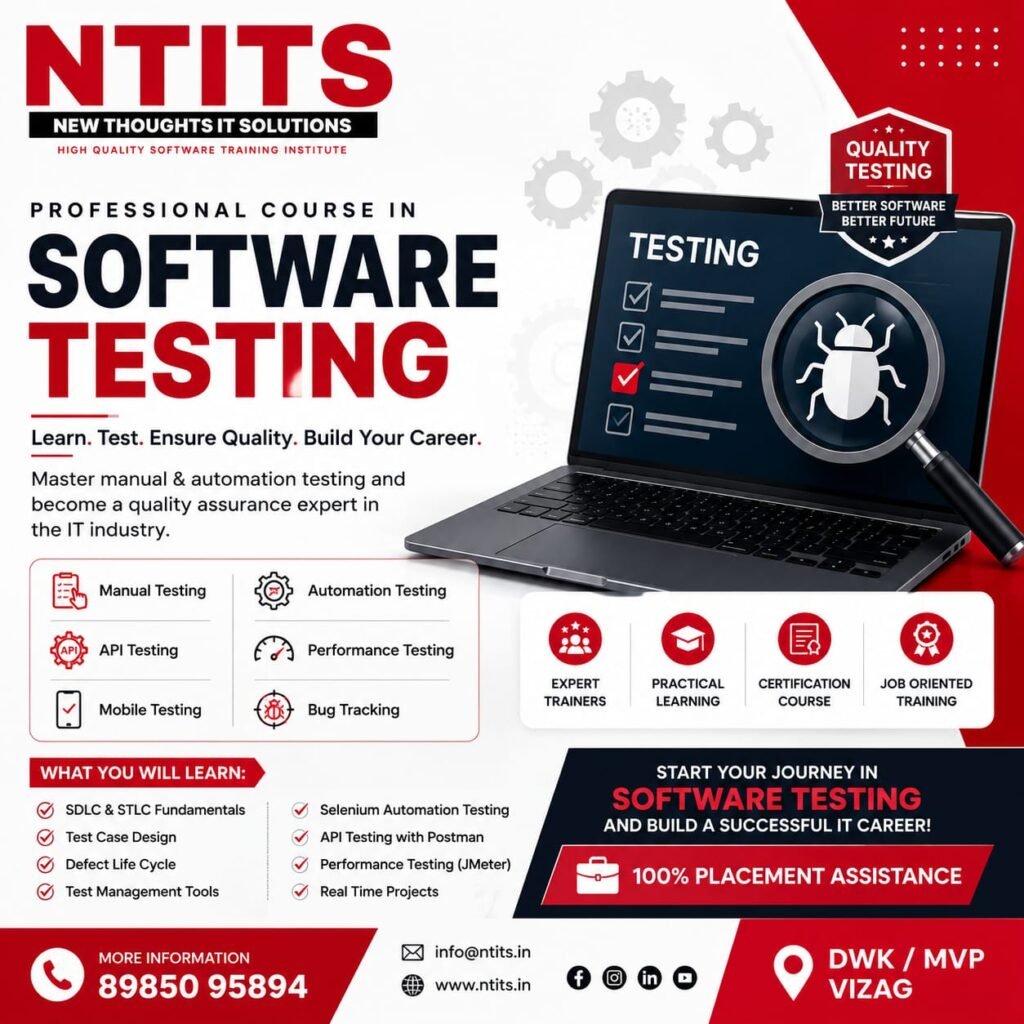
What Will You Learn at NTITS Institute?
The course can cover important areas of software quality assurance, including:
- Fundamentals of software testing and quality assurance
- Software Development Life Cycle (SDLC)
- Software Testing Life Cycle (STLC)
- Test planning and test case design
- Functional and non-functional testing
- Manual testing techniques
- Regression and retesting
- Defect identification and reporting
- Agile and Scrum methodologies
- Introduction to automation testing
- Testing tools and frameworks
- Real-time project-based testing practices
- Interview and career preparation
Manual and Automation Testing Skills
A strong testing professional should understand both manual and automated approaches.
Manual testing helps learners develop a solid foundation in requirements analysis, test execution, exploratory testing, and defect reporting.
Automation testing introduces learners to tools, frameworks, and programming concepts that can improve testing efficiency and support repetitive test execution.
Learning both areas can give students a broader understanding of modern software quality practices.
Who Can Join a Software Testing Course?
A software testing course can be suitable for:
- Fresh graduates looking to enter the IT industry
- Students interested in software quality assurance
- Professionals planning to move into software testing
- Developers interested in improving their testing knowledge
- Job seekers looking for an IT career path
- Anyone interested in learning manual and automation testing
Prior experience may depend on the course structure and eligibility requirements of NTITS Institute.
Career Opportunities After Software Testing Training
After completing software testing training, learners can explore roles such as:
- Software Tester
- QA Tester
- Quality Assurance Analyst
- Manual Testing Engineer
- Automation Testing Engineer
- Software QA Engineer
- Test Analyst
The exact career path can depend on your technical skills, practical experience, certifications, and interview performance.
Why Practical Training Matters
Software testing is a hands-on field. Understanding concepts is important, but applying those concepts to realistic applications can make learning more effective.
Project-based training can help students practice writing test cases, executing test scenarios, documenting defects, working with development teams, and understanding how testing fits into the software development process.
Start Your IT Career with NTITS Institute
Choosing the right training institute is an important step toward developing industry-relevant skills. If you are interested in software quality and want to build a foundation in manual and automation testing, explore the Software Testing Course at NTITS Institute and learn how the program can support your career goals.
Frequently Asked Questions
1. What is a Software Testing Course?
A Software Testing Course teaches the concepts, techniques, tools, and processes used to evaluate software applications, identify defects, and improve software quality.
2. Is software testing a good career option for beginners?
Yes. Software testing can be an entry point into the IT industry, particularly for learners who develop strong testing fundamentals, technical skills, and practical project experience.
3. Does the NTITS Software Testing Course include automation testing?
The course curriculum should be checked with NTITS Institute for the latest details regarding automation tools, programming languages, and frameworks covered.
4. Can freshers join a Software Testing Course?
Many software testing programs are designed for beginners and fresh graduates. Students should confirm the eligibility requirements directly with NTITS Institute.
5. What is the difference between manual testing and automation testing?
Manual testing involves executing test scenarios manually, while automation testing uses scripts and testing tools to automate selected test activities.
6. What skills are important for a software tester?
Important skills include analytical thinking, attention to detail, knowledge of testing methodologies, communication, documentation, defect reporting, and familiarity with relevant testing tools.
7. Will software testing training help with IT job interviews?
Practical training can help learners understand testing concepts and prepare for technical discussions, testing scenarios, and commonly asked interview questions. Career outcomes depend on individual preparation and performance.